
Test and learn update
People are willing to ask. The harder part is knowing how to act.
Early Ask and Act testing in Aberdeen is showing that professionals are willing to ask about housing insecurity. The harder part is knowing what to do next.
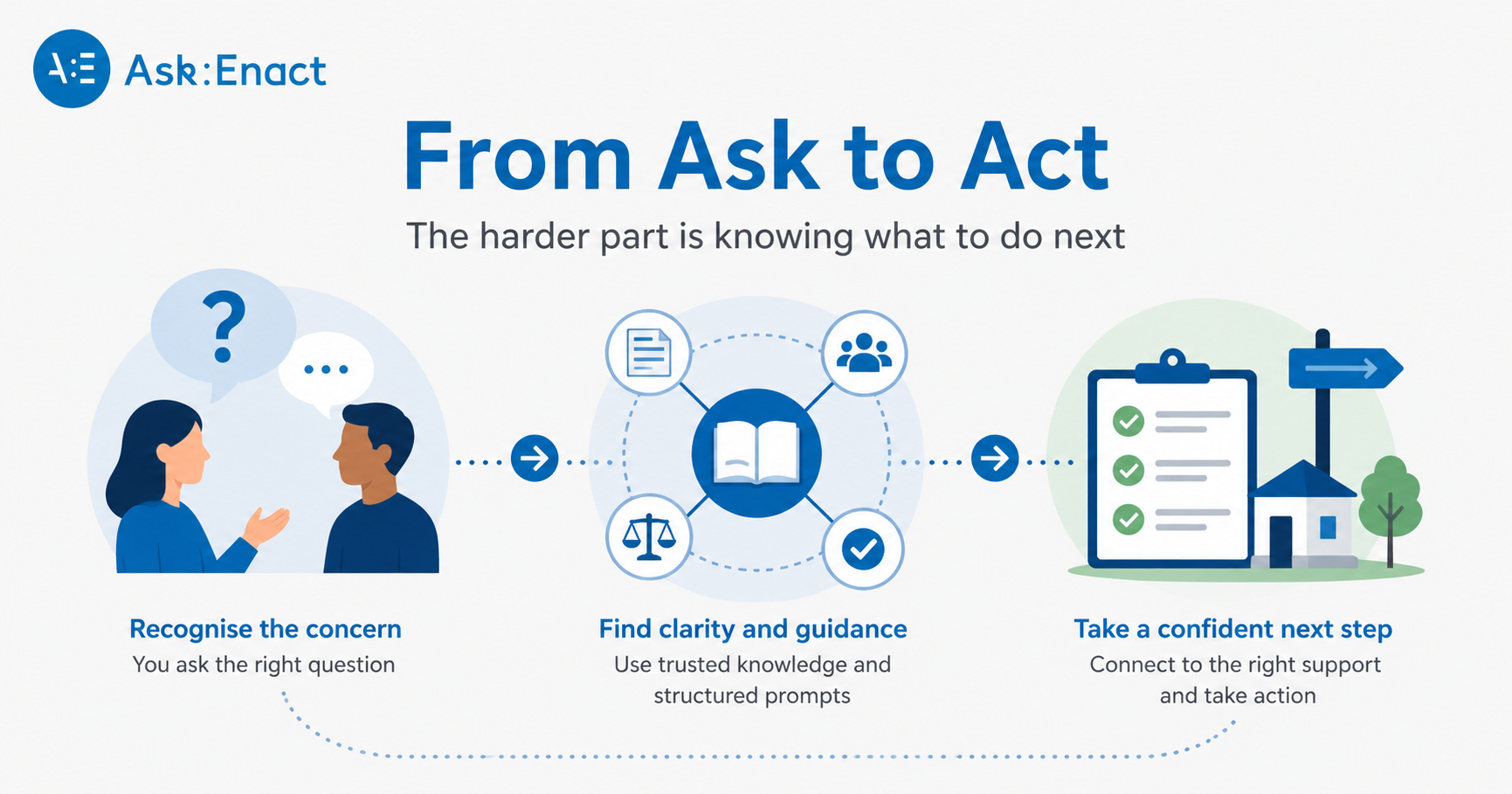
We are starting to see something useful from the early Ask and Act testing in Aberdeen.
The issue is not simply whether professionals are willing to ask about housing insecurity. In many cases, they are.
The harder bit is knowing what to do next.
That matters because Ask and Act is not just about asking a better question. It is about helping people earlier, before housing problems turn into homelessness, crisis, or another referral being passed around the system.
A good question can open the door. But if the person asking does not have easy access to the right guidance, the right service information, or a clear next step, the opportunity can still be missed.
What we are learning
As part of the Ask and Act Test and Learn Pilot in Aberdeen, frontline teams have started testing how this works in practice.
The Community Learning and Development Team have been using Ask and Act in their day-to-day work. Police Scotland have also tested the approach in Tillydrone. NHS and Allied Health Partners have now been briefed and are preparing to start their own testing.
The early picture is useful.
Staff are not saying they are unwilling to ask. Initial survey feedback from the Community Learning and Development Team suggests confidence in discussing housing insecurity is relatively strong.
But the same feedback points to a more practical problem.
Confidence depends on being able to find, understand and use the right information when it is needed.
That will not surprise anyone who has worked in frontline services.
Housing insecurity is rarely neat. It often sits alongside money worries, family breakdown, health issues, language barriers, digital exclusion, safety concerns, or complex household situations.
People do not always say, “I am at risk of homelessness.”
Sometimes the signs are much smaller.
Someone might mention rent arrears. They might be staying with a friend. They might be avoiding going home. They might be struggling to manage letters, appointments or online forms. They might say something in passing that suggests things are starting to unravel.
A professional may spot that something is not quite right. They may ask a sensible question.
Then comes the difficult bit.
What do you do with the answer?
Asking is only half the job
There is a risk that Ask and Act gets understood too narrowly.
If we treat it as “ask a housing question”, we miss the point.
The question only matters because it creates a chance to act earlier.
That action does not always need to be a referral. It might be advice, reassurance, a signpost, a follow-up conversation, or helping someone understand their options before things get worse.
But it does need to be informed.
Early feedback is already showing some common themes. Staff need easier access to referral information. Follow-up after signposting is not always clear. People are not always sure which service is the best fit. Some of the barriers people face are not housing issues on their own, but they still affect whether someone can keep or access a safe home.
That is the gap Ask:Enact is being built to support.
This is not about criticising frontline staff
It would be wrong to frame this as a lack of commitment or skill.
Most frontline staff are already working with people in difficult situations. They are used to sensitive conversations. They often know when something feels wrong.
The problem is that no one can hold every policy, service pathway, eligibility rule and referral option in their head.
That is especially true when housing is not their main role.
A community worker, police officer, health professional, support worker or third sector worker may all come across early signs of housing insecurity. But they will not all have the same housing knowledge.
And they should not have to become housing specialists to take a useful first step.
The better question is:
How do we help professionals act with confidence at the point they notice a concern?
Where Ask:Enact fits
Ask:Enact is being developed to support that moment.
It is not there to replace professional judgement. It is there to make professional judgement easier to apply.
The aim is simple.
A professional describes a situation in plain language. Ask:Enact helps identify risk and urgency, suggests useful follow-up questions, and gives clear next steps based on reliable guidance and local pathways.
That could mean advice. It could mean a signpost. It could mean a referral. It could mean recognising that the situation is more urgent and needs immediate action.
The point is not to add another layer of process.
The point is to close the gap between spotting a concern and knowing what to do next.
What we are doing now
The system is being shaped by what staff are telling us during testing.
That includes how guidance is presented, how service information is accessed, what outputs are useful, and how the system needs to work in real frontline conditions.
We are also developing a services dashboard as an interim step. This is to help teams get easier access to service and referral information while Ask:Enact moves towards wider onboarding and live testing.
That might sound like a small thing, but it matters.
If staff are telling us they need easier access to the right information, then we should respond to that now, not wait until the final version of the system is ready.
Prevention needs to be practical
The principle behind Ask and Act is strong.
Earlier conversations can lead to better outcomes.
But only if people are supported to do something useful after the conversation starts.
That means guidance needs to be easier to access. Services need to be easier to understand. Referral routes need to be clearer. The next step needs to feel manageable.
The early learning from Aberdeen is not that Ask and Act is unrealistic.
It is that prevention needs practical tools around it.
That is what we are trying to build with Ask:Enact.
Something that helps professionals ask earlier, act more consistently, and learn from what is happening before people reach crisis.